
The Slopconomy and its Alternatives
As agentic AI grows, human verification remains bound by the biological constraint of embodiment. A wide-ranging interview with Christian Catalini, researcher at MIT’s Sloan School of Management.

Expectations are that AI will automate a significant percentage of the knowledge economy’s workforce and make their jobs
redundant. We dig into the futurist toolbox to interrogate this assumption – punctuated by a provocative scenario snippet from 2030.
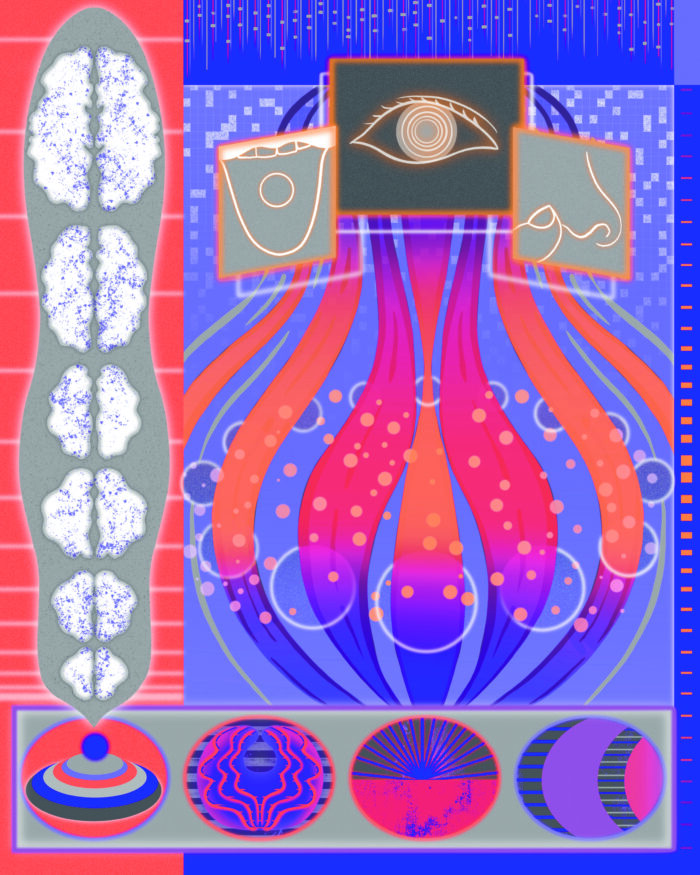
Illustration: Sophia Prieto
“AI could wipe out half of all entry-level white-collar jobs – and spike unemployment to 10-20% in the next one to five years.”
This inflammatory statement was made by Anthropic CEO Dario Amodei in an interview with Axios in 2025. Although provocative, it is by no means the most controversial prediction regarding the potential near term impact of AI made recently by some of the most influential figures in tech. Let us highlight a few.
In an interview at World Economic Forum’s annual meeting in January 2026, Alex Karp, the CEO of Palantir, said that AI “will destroy humanities jobs”. Later, in an interview on TBPN, he doubled down and said that only people with vocational training or neurodivergence have a future. A similarly sombre prediction of the near future white-collar job market has been heard from Sam Altman, who has said that “the job destruction in the next couple of decades is going to be massive.” Elon Musk and Mark Zuckerberg have both said similar things.
Broaden your horizons with a Futures Membership. Stay updated on key trends and developments through receiving quarterly issues of FARSIGHT, live Futures Seminars with futurists, training, and discounts on our courses.
become a futures memberA common thread in the discussions around the imminent replacement of the knowledge worker is that AI is qualitatively different from previous technological leaps that have led to a re-shuffling of the labour force. AI, many argue, is not merely another technological tool to be wielded in different contexts and functions. Rather, it connects all other tools, automates them, and directs them autonomously. All while being on a recursive learning bender, it’s worth adding.
Yann Lecun, AI nestor, Turing Award-winner, and former Chief AI Scientist at Meta, disagrees. “Dario is wrong. He knows absolutely nothing about the effects of technological revolutions on the labor market. Don’t listen to him, Sam, Yoshua, Geoff, or me on this topic. Listen to economists who have spent their career studying this (…)”, he recently wrote on X, in response to a clip from Fox News where Amodei once again reiterated his gloomy predictions.
So far, predictions of AI killing jobs have not come true. Recent US labour market data, shared by The Economist, offers a (still preliminary) snapshot of how the AI shift is intersecting with employment. At a macro level, white-collar employment has continued to rise over the past three years, alongside an expanding wage premium relative to blue-collar work, with one notable exception: more routine back-office roles.
Over the same period, the United States has added around 7% more software developers, 10% more radiologists, and 21% more paralegals. Some of the fastest growing white-collar categories are also those that don’t yet have settled names: “other mathematical science occupations” have grown by roughly 40% since late 2022, with real wages up by about a fifth; “other computer occupations” (including systems architects and IT project managers) have also expanded rapidly. Meanwhile, employment among “business operations specialists, all other”, a catchall category spanning process design, coordination, and analysis, has increased by close to 60%, with solid wage growth accompanying it. Taken together, these signals suggest resilience in parts of the knowledge economy, even as the distribution of gains – and the longer-term impact on task composition – remains uncertain.
Clearly the owners and CEOs of major AI companies have a vested interest in drumming up hype around the transformative power of AI, and these incentives must be taken into consideration. Dario Amodei is the CEO of Anthropic, a company that relies on continuous investments to keep scaling. Yann LeCun has left Meta and has founded AMI, a new research lab that works to build AI on a different and competing architecture to large language models. He recently raised more than $1 billion in the largest ever seed-round for a European company. But it is also worth noting that independent experts have made similar predictions.
In their widely distributed AI 2027 scenario, The AI Futures Project, a nonprofit forecasting the future of AI, predicts that in October 2027 AI will have the “ability to automate most white-collar jobs.”
The emergence of new technology has a long history of sorting people into three groups. On one side there are the techno-evangelists, usually on the overly optimistic side in their estimation of both the pace of technological disruption and its positive benefits. Then we have the techno-pessimists. They often assume that the emergence of new technology will invariably lead to dire consequences – job loss, cultural decay, and the inevitable downfall of mankind. The pessimists tend to align with the evangelists in their expectations of the scale and rate of change as well as the severity of its consequences. These two groups tend to have the most dramatic and compelling narratives about the emerging future, they are animated by the perceived up- or downside and thus they tend to get the lion’s share of attention from the media and the commentariat.

Explore the world of tomorrow with handpicked articles by signing up to our monthly newsletter.
sign up hereAs long as there have been doomers and utopians, there have also been those who will huff defiantly at the dominating narratives. The sceptics, let’s call them, predictably oppose the allure of shiny new technologies and the promise of a swift tech-revolution. The sceptics will often default to historical comparison and make the (safe) bet that nothing much is going to change despite the frenetic hand waving of others.
These three archetypes in the discourse roughly correspond to their respective corners of what futurists call “The Futures Triangle” – a tool developed by Sohail Inayatullah. It serves as a guide to steer our thinking and map the dynamics at play when change occurs across three different time dimensions.
The corners in The Futures Triangle represent the push of the present, the pull from the future, and the weight of history. The tension and interaction between these three forces highlights that the way change occurs depends on the outcome of the ‘friction field’ created by their interplay. This helps futurists recognise that change is often not straightforward, and always multifaceted, as it is shaped by interacting forces operating on different time dimensions.
But then there’s the fourth group. Know-it-alls who advocate for a reasonable middle-ground. Futurists often fall squarely into this, let’s be honest, annoying group. People who sit with their arms crossed in the corner of the conversation, ready to interject with a quietly measured throat-clear to educate the three other groups on the complexity of intersecting societal dynamics and the value of sticking to plausible future scenarios.
At CIFS, we would normally position ourselves above the trenches and insist that we need to take all the above dynamics into account and produce sensible, balanced, and plausible scenarios free from the biases and incentives that pollute AI discourse. The scenarios would serve as narrative tool, allowing decision makers to picture different future outcomes and prepare more robust decision making.
Here, we will try to do things a little differently. We will take the predictions at face value and see where it leads us. What if it is true that AI will wipe out 50% of white-collar jobs and spike unemployment in the span of just a few years? If technical progress follows this predicted course, how would the rest of society need to adapt for AI to prove this disruptive? What major decisions, events, and inflection points would need to occur for us to arrive at the future Dario Amodei predicts by say, 2030? Such critical inflection points, of course, are not as rare as we might think. The recent past offers compelling evidence.
In early January 2020 a 61-year-old Chinese woman from the Wuhan province flew to Bangkok, Thailand. Upon arrival she was flagged by airport security and was quarantined with symptoms of the novel coronavirus. She became the first confirmed case outside of mainland China. A few months later, on March 8th, Kitzloch, a popular afterski bar in the Austrian ski resort Ischgl became an infamous COVID-19 hotspot after an infected bartender’s whistle was passed around the crowded tourist bar. In the nearby city of Bergamo, Italy, images of military trucks filled with coffins soon spread around the globe. On March 12th, US President Donald Trump suspended air travel to and from 26 European countries. The global pandemic was a reality.
For knowledge workers, the years of lockdowns that followed sparked the widespread adoption of remote collaboration tools, video conference platforms and home offices. Studies have since shown that workers are as productive working remote as in the office and that workers, especially younger ones, tend to prefer a job that allows for the flexibility to work from home. Since the lockdowns were lifted, some organisations have reduced or even put a permanent stop to remote work, but many of the tools that facilitated it are still widely used with many workflows remaining fully digitised. As such, a part of the foundation for the potential automation of knowledge work was laid 10 years before our current slew of AI predictions.
In Europe, we might argue that another inflection point paving the way for rapid transition to an AI economy came in September 2024, when Mario Draghi, former Italian Prime Minister and President of the European Central Bank, presented the report “The Future of European Competitiveness”, commonly dubbed the Draghi Report. Draghi concluded what anyone paying attention already knew: Europe lagged China and the US in technological innovation and needed to apply bold policy changes to remedy the situation. AI sat in the heart of the issue.
In January 2025, as a response to the Draghi Report, the European Commission presented its Competitiveness Compass, a “roadmap to restore Europe’s dynamism and boost our economic growth”, along with the “Apply AI” strategy with the purpose of accelerating time-to-market. Although the political response to the report has been more gradual than revolutionary, it shows that political will too can be mustered in the face of necessity, even in Europe’s lumbering democracies.
It’s also clear that several important structural shifts have already occurred in the recent past that pave the way for a quick adoption of AI tools across organisations. But is that really enough to allow for a plausible future scenario where “AI has wiped out half of all entry-level white-collar jobs – and spiked unemployment to 10-20% in the next one to five years”? Is it enough that white collar work has in large part been digitalised and that the EU is softening regulations on tech? At the time of writing this, in June 2026, we have yet to see prophesised massive effects of AI on the job market. For the prediction to come true, more structural inflection points are needed in the coming years. Perhaps there are simply too many converging and individually improbable enablers that would need to come together for the prediction to be plausible.
What would need to be true for the future to unfold as predicted? What could such a scenario look like?
This brings us to 2030…
It’s Tuesday morning. Spring was late to arrive, but today the warm sun paired with half empty streets makes it feel like August. Christine Durand swipes her key card to bring the elevator to the top floor of the imposing Parisian office building. She checks her emails as she walks to the kitchen for coffee. It’s a normal workday but the kitchen is quiet. It is most days. As the CEO of the European Insurance behemoth Prévoyance Industrielle de France she has facilitated the rapid onslaught of AI in the insurance industry. After the COVID-19 pandemic fizzled out, most workers returned to the office, and she has fond memories of the few years where the old hustle and bustle in the office seemed back to normal. Now the office feels even quieter than during the lockdown.
Coffee in hand, Christine greets a few dispersed clusters of employees as she makes her way towards the corner office. As tables and chairs were moved out of the office in concert with layoffs, much of the floorspace became repurposed for socialising or hosting workshops. There was even space for meditation corners. Yet the building still feels half empty, and she’s struck by a strange tenderness as she walks through it. This last year has been especially brutal, and many of PIF’s competitors have gone bankrupt. Most in the industry were hesitant to make the tough but necessary business decisions early on. It is far too easy to close your eyes to the future if you don’t like what you see. Christine was not in that group. Together with the rest of the senior management and the board, she decided early on that PIF needed to lean heavily into the AI revolution. They were among the first in France to make AI training mandatory, roll out enterprise agentic AI solutions across their verticals and, most importantly, she implemented an organisation-wide hiring freeze in 2026.
France has some of the most robust labour laws in the world. Even if many of its thousands of actuaries, risk analysts, account managers, marketing and communication specialists were made redundant, it would be far too expensive to outright fire people, both due to long binding salary compensations as well as in terms of publicity, pressure from unions and from political parties. By simply choking the entry point, PIF reduced staff in a slow but steady manner.
The insurance industry was ripe for automation. Partly because of the numerical nature of the business, but also due to the extensive regulations and data management at the core of the industry. AI was an unstoppable superhuman mathematician who never slacked on compliance and who never stopped working. Insurance was of course just one among many industries that restructured their business model to fit the new reality.
As university graduates entered a barren job market, widespread discontent ensued. Politically, it was easy to ignore the graduates. On one hand, it became a perfect opportunity to promote the virtues and rights of skilled labourers, teachers and nurses – now more needed than ever to care for an aging population. On the other hand, it was used as a good case to position France and French companies as a front runner in the global AI race and to attract further investments.
After the Draghi Report provoked European leaders into deregulating and investing heavily in homegrown AI, France went further, offering economic incentives and tax deductions for compute purchases. Where neighbouring countries had been stifled by the rising cost of data centres, frontier chips, and energy – costs that made hiring juniors seem almost rational again – France saw an opportunity. It had its own AI labs, reducing dependency on American and Chinese models. Energy was also less of an issue, given that France produced more nuclear power than the rest of the continent combined. Stable electricity, domestic AI capabilities, and political will converged.
Christine glanced through the panorama window from her office overlooking the 2nd arrondisement. The view never failed to inspire awe, but something had changed in the last years. It was notable now how much less busy the city felt now, even during rush hour. In just a few years, Paris traffic had gone from infamously hectic to serene. She felt sorry for the young job seekers, of course. On the other hand, if they could use AI to cheat on their exam, could they not have expected it to automate away the very jobs they needed the exam for?
Shortly after rolling out a flurry of pro-AI initiatives, the French government introduced economic incentives to smoothen the transition to an automated workforce as well. Education reforms lessened intake at traditional university educations and increased intake in technical schools. Programs were implemented for workers at the end of their work life to help them gradually transition to peoplefacing occupations – teachers, nursery workers, or hospital orderlies. At first many were sceptical of the prospect of giving up their lucrative careers, but this slowly changed as word spread of better work-life balance, more meaningful work, and increased reported life satisfaction from participants in the program. The transition was not frictionless. With growing unemployment and a larger share of the workforce on part time contracts, the economy slowed down. National debt and interest rates hiked while the European Central Bank were hesitant to assist.
Christine turned to the flatscreen TV on her office wall. The automated performance dashboards circulated quietly. In only a few short years the company headcount was reduced significantly, while the turnover remained steady. Everything suggested that PIF would survive the AI transition just fine. But she did not fool herself. At some point in the near future, even her role would also be automated. She had already started to plan for that future…
A completely fictional story, yes, but one that highlights the necessary speed of converging decisions and developments needed – all occurring without much friction – for the boldest AI predictions to come true. In such rapid transition scenarios, more than just technical developments matter. “Knowledge work” is a messy category that entails more types of tasks than the predictions usually assume. Wrangling difficult clients, planning projects, aligning internal expectations, managing teams of colleagues, addressing unforeseen disruptions, building trust, or laying a plan for merging legacy systems with new software. These are all types of tasks which are common in knowledge work but depend on relational skills, organisational knowledge, and tacit know-how which are difficult to automate.
On the level of politics, barriers to a rapid transition scenario are equally apparent. Is it feasible that governments, bound by existing political agreements, conventions and regulations, enact policy decisions that support a rapid shift to an augmented AI economy, while also being able to implement them fast enough for organisations and people to adapt in only a few years? Is it plausible that citizens will simply take their seats on this AI automation ride without knowing where it ends?
The job of futurists is not only to envision ideas about the future, informed by a balanced relationship between the forces of the present and the weight of the past, but also to try to understand how the developments that shape the future interact with one another. This scenario required a government that moved quickly and coherently, citizens who adapted without revolt (in France), and a labour market able to absorb the shock gradually enough to avoid a political crisis. Introduce friction or remove one of those assumptions and the scenario collapses. The argument here is for taking seriously what predictions actually demand of the technology, but more importantly, of the world surrounding it.
This article was first published in Issue 18: On Autopilot