We use our own cookies, as well as those of third parties, for individual as well as repeated sessions, in order to make the navigation of our website easy and safe for our users.
In turn, we use cookies to measure and obtain statistical data about the navigation of the users. You can configure and accept the use of the cookies, and modify your consent options, at any time.
Since its invention in the sixteenth century, the idea of ‘Utopia’ has carried an inherent ambiguity that clings on today, as visions of utopia are making a comeback among tech billionaires and Saudi Arabian royalty alike.
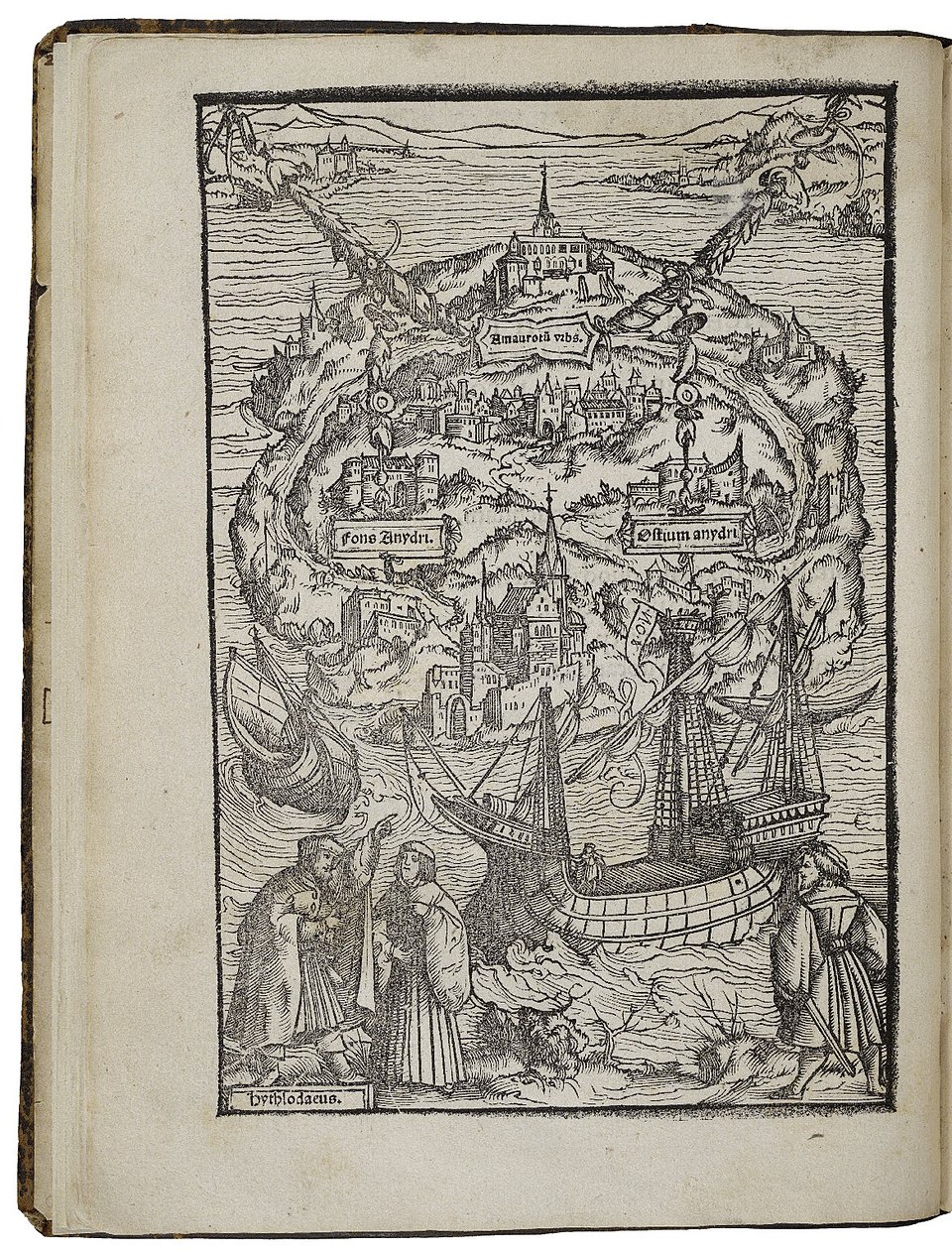
Picture: A woodcut by Ambrosius Holbein, illustrating a 1518 edition. In the lower left, Raphael describes the island Utopia.
Mads Vindaal
February 5, 2026
Imagine a 170-kilometre mirrored megastructure slicing through the Saudi desert – minimalist, monumental, like an artefact from Dune. That’s The Line: the Saudi crown prince Mohammed bin Salman’s vision of an indoor city, built for nine million inhabitants. Inside, high-speed pods transport residents to algorithmic workplaces; food grows in hydroponic farms; smart systems manage daily life, freeing time for creativity and friendship.
Or picture Elon Musk’s Mars: a network of radiant domes and tunnels glinting under the pale sun, home to a million human pioneers. Rovers and high-speed trains connect farms and laboratories, while ice reserves power the planet’s self-sustaining life-support systems.
Subscribe to FARSIGHT
Broaden your horizons with a Futures Membership. Stay updated on key trends and developments through receiving
quarterly issues of FARSIGHT, live Futures Seminars with futurists,
training, and discounts on our courses.
A strange new race has begun. From Balaji Srinivasan’s decentralized crypto state near Singapore to Marc Lore’s Telosa, Jeff Bezos’ space colonies, and Peter Thiel-backed plans of a city in the jungle of Honduras – some of the wealthiest people on Earth are now competing to construct futuristic cities, aiming to shape new collective visions of a radically different future.
“In a way, it will be a utopia,” declares the website of NEOM, the broader Saudi megaproject that encompasses The Line. Marc Lore, former President and CEO of Walmart US eCommerce, has described his proposed Telosa City as an “overlap between [the] pragmatic and utopia.” Musk calls himself a “utopian anarchist” and links Mars to a future free from material scarcity, while Jeff Bezos and Peter Thiel promise new systems of law, governance, and freedom.
This revival of utopian imagination marks a notable shift. Only a little over a decade ago, Francis Fukuyama’s 1989 hypothesis of “the end of history” still held sway. During the Cold War, utopian imaginations had flourished as a horizon of expectation, but the fall of the Soviet Union led to a drastic exhaustion of such fantasies on a global scale. Throughout the following two decades, a broad consensus appeared to echo Fukuyama’s claim that the new era revealed liberal democracy to be the final stage of human civilization. Now, the consensus has fractured. Utopia is back– but in what form, and in whose hands?
The utopian puzzle
It came into the world as a deeply ambiguous idea. In 1516, the English humanist philosopher and royal adviser to King Henry VIII, Sir Thomas More, introduced the concept through his fictional travelogue Utopia, in which Raphael Hythloday, a long-bearded Portuguese sailor, recounts his discovery of an island whose laws and customs are unlike any in Europe.
More deliberately played on a linguistic double meaning: utopia could derive from eu-topos (“good place”) and ou-topos (“no place”). It literally meant “the nonexistent good place.” But was it to be understood as the good place that could never exist anywhere, or the good place that did not yet exist?
On the one hand, Utopia belongs to the Platonic dialogue tradition. Like Socrates in The Republic, Hythloday debates justice and governance, defending Utopia as an ideal society where poverty and private property are abolished; citizens enjoy leisure, free healthcare, and education; government is meritocratic; religions coexist; and laws are few.
On the other hand, the book embraces the political satire of More’s age. Hythloday’s name means “speaker of nonsense,” and Utopia often seems as absurd as it is ideal: bureaucracy rules daily life, travel requires permission, leisure is supervised, and even marriage involves state inspection – couples must view each other naked to avoid later regret.
Political treatise or jeu d’esprit? 2026 marks the 510th anniversary of the book, and the dispute remains unsettled. “Utopia remains an exceptionally puzzling work,” writes intellectual historian Quentin Skinner: “while it is unquestionably the greatest contribution to the political theory of the northern Renaissance, it also embodies by far the most radical critique of humanism written by a humanist.”
More’s contemporaries were far less troubled by this ambiguity. Upon its release, the book was immediately celebrated as a visionary classic. “Utopia is a place… to be desired by all people,” wrote the humanist patron Jeroen van Busleyden in 1516, encapsulating the widespread mood. The French humanist Guillaume Budé even credited it with curing him of greed: reading about Utopia’s communal life made him lose all interest in his estates and wealth. This was not a celebration in neglect of its satirical dimension – the ambiguity was its strength.
Utopia was seen as a critical mirror reflecting England’s inequality and unrest while questioning the very idea of an ideal society. Rather than a reform blueprint, it was a method of critique. “He published Utopia with this purpose – to indicate under which circumstances republics are less well off,” wrote Erasmus of Rotterdam in 1519. More had discovered a new mode of political thought that would evolve throughout modernity.
From “no place” to “good future”
When writing Utopia, More stood at the twilight of the Middle Ages and the dawn of modernity. The book anticipated several modern concerns – private property, communal ownership, and religious freedom – yet remained deeply premodern.
According to the German philosopher Ernst Bloch, More lacked a modern understanding of social change. More’s utopia was not a collective achievement but the creation of an enlightened ruler. Bloch saw this as a characteristic feature of all utopian fiction before the eighteenth century – even technological utopias such as English philosopher and statesman Francis Bacon’s New Atlantis (1627), where perfection was understood as the collective efforts of human science.
Bacon reoriented utopian thinking toward empirical knowledge, envisioning a society governed by scientific inquiry and even foresaw inventions like submarines, weather control, and flying machines – yet, he wasn’t able to predict a transformation of power itself. For Bacon as for More, the reformer of the new society had been a benevolent king. This, according to Bloch, is why early utopias were pictured in “faraway wishlands” rather than as restructured versions of existing societies.
However, at the end of the eighteenth century, utopia ceased referring to an impossible place in the present and came to refer to a possible place in the future. Why did it happen? The shift was a direct product of the drastic transformation European societies were undergoing at the time. The French Revolution fostered visions of a future utopia rooted in the universalist politics of liberté, egalité, fraternité. Simultaneously, the growing productivity of the Industrial Revolution inspired utopian imaginings of material abundance. Accelerated changes of political and social circumstances fostered new forms of poverty and hardship, but also widespread hopes that the future could be better than the present.
From this dual revolution, a range of political ideologies – liberalism, socialism, communism, and anarchism – began to envision a future society. As different as they were, argues British historian Eric Hobsbawm, they all shared a common utopian vision of “gentle anarchy,” namely, “a world in which all were happy, and every individual fully and freely realized his or her potentialities, in which freedom reigned and government coercion had disappeared” – a vision that echoes both the early utopian socialists – such as Charles Fourier and Robert Owen – who imagined voluntary cooperation and the end of private property, and Enlightenment liberals like Condorcet, who saw history as a project of emancipation moving toward equality and progress.
In earlier centuries, utopian fantasies were only isolated dreams without social resonance amongst the broader populations in European countries. It had remained the visions of intellectuals hoping to influence their sovereigns, rather than one in which the majority could take part in its construction. With 19th century industrialisation and urbanisation, “the masses” was born as a social phenomenon with a permanent presence. With this started an era of struggle centered around what cultural theorist Susan Buck-Morss has called “the dream of a mass utopia.”
Simultaneously, the utopian ambiguity evolved. The two meanings of utopia – the optimistic and the pessimistic – both continued to exist, but they stopped being entangled as they had been in More’s Utopia. Instead, they split apart into two opposing camps: the utopians and the anti-utopians.
In opposition to the new utopians, a range of anti-utopian perspectives emerged, suspicious of the dreams of a harmonious future. In The Communist Manifesto (1848), Karl Marx and Friedrich Engels warned against “ready-made utopias” prescribing freedom in advance; the new society, they argued, would emerge through history itself. Around the same time, Alexis de Tocqueville feared that the pursuit of perfect equality could end in a quiet tyranny, where order stifles liberty.
From “good future” to “no future”
Up through the nineteenth and early twentieth centuries, both utopian and anti-utopian voices managed to appeal to populations across the Western world. But by the mid-twentieth century, anti-utopianism was gaining ground in Western countries. Utopia became increasingly synonymous with political horror. A growing number of people sensed that the utopian dreamworld had turned into a nightmare.
The Austrian philosopher Karl Popper’s famous essay “Utopia and Violence” (1947) crystallised this disillusionment, warning that the dream of perfection, once armed with power, easily becomes its opposite. In her The Human Condition (1958), German political thinker Hannah Arendt described the “Utopian hubris” as a homogenising “destruction of plurality.” And in a radio debate from 1964 titled “Possibilities of Utopia Today,” even the Marxist utopian philosopher Theodor W. Adorno voiced reservations, stating that towards utopian fantasies of the future he felt as Judaism did toward images of God – “Thou shalt not.” Similar to the ban of representations of God in the Torah, politics had to ban representations of utopian fantasies, he argued. Such fantasies would inevitably do violence to reality when reality refused to fit.
The growing anti-utopianism that emerged through the second half of the twentieth century didn’t mean that utopianism vanished immediately. The revolts of 1968 carried the impulse back, as students and workers demanded not only new institutions but new ways of living. So did the environmental movements of the 1970s, where the dream of liberation fused with the dream of ecological connectedness. And in literature, the speculative fiction of writers such as Ursula K. Le Guin and Octavia Butler reimagined community, ecology, and gender as terrains of emancipation.
Yet, over the century’s final three decades, utopianism slowly receded. The 1973 oil crisis ended the three postwar decades often referred to as the “golden age of capitalism.” A combination of rising unemployment and high inflation shattered faith in Keynesian, state-managed growth, and a new era of economic privatisation began. According to the Italian philosopher Franco Bifo Berardi, a new collective mood took hold thereafter – culturally it surfaced in the 1977 punk slogan “No Future”. Politically, British Prime Minister Margaret Thatcher turned it into a doctrine: “There Is No Alternative” – a watchword that political proponents of capitalism would repeat around the globe. The utopian horizon grew foggier by the day.
As the Cold War ended, the utopian horizon had disappeared. For the many liberalist disciples of Fukuyama, this led to the conviction that liberal democracy represented “the end point of mankind’s ideological evolution.” But while “the end of history” encapsulated a dominant mood, Fukuyama’s hypothesis nonetheless met criticism from the outset.
GET FARSIGHT DELIVERED TO YOUR INBOX
Explore the world of tomorrow with handpicked articles by signing up to our monthly newsletter.
Several conservatives argued that the liberal euphoria was an illusion that would sooner or later burst. Fukuyama’s former teacher, Samuel P. Huntington, argued that new religious, cultural, and civilizational fault lines would replace ideological ones. The political scientist John J. Mearsheimer foresaw renewed competition between powerful nation states.
Critics on the left likewise questioned the narrative, insisting that at some point optimistic proponents of “the end of history” would have to confront the intensifying inequality, instability, and ecological degradation produced by globalised markets. The Marxist cultural theorist Fredric Jameson argued that the widespread belief in “the end of history” did not signal a diminished need for utopian visions; rather, it revealed a global crisis of political imagination. “It seems to be easier for us today to imagine the thoroughgoing deterioration of the Earth and of nature than the breakdown of late capitalism,” Jameson wrote in 1994.
There was, however, a certain truth to the narrative of “the end of history.” After the Cold War, time was sensed differently, as the old ideological struggles that used to give history a direction no longer served as points of orientation.
The disappearance of the utopian horizon had led to a more general disappearance of the horzion of expectation. “For the first time in history,” Eric Hobsbawm wrote in Age of Extremes (1994), “we do not know where our journey is taking us, or even ought to take us.”
By the turn of the millennium, Tony Blair’s British Labour government opened the Millennium Dome in Greenwich – an 87.000 square meters exhibition space meant to celebrate the year 2000 as a showcase of Britain’s modernity and future aspirations. Inside, visitors wandered through twelve themed “zones” representing aspects of contemporary life – body and mind, work and learning, faith and spirit, culture and play, science and technology etc. It became one of New Labour’s early fiascos: a spectacle of empty slogans in search of a story. Committees and consultants multiplied, but no coherent vision was there. Visitors struggled to discern what future was being proposed – the Dome became an absurd spectacle, manifesting that the future had truly grown opaque.
From “no future” to “bad place”?
Something has happened to our sense of the future in recent years. From global pandemics to ecological degradation, and from economic turbulence to increased political polarisation – a sense of crisis in the global order has revitalised the need for new visions of the future. After the collapse of the Soviet Union, few would have guessed that tech billionaires would become the pioneers in reviving the utopian tradition once again.
So how do we approach this era of revived utopian imagining? In essence, utopian fantasies are concerned with the present. They envision a different society to cast light back onto what seems unjust or incomplete in the society that envisions them. But as the psychoanalysts remind us, no fantasy is ever fully transparent to its dreamer. As much as the utopian vision can reveal what is lacking, even the most self-aware utopias bear the marks of their own limits.
Plenty of constraints come to mind when we approach the utopian dreams of today’s wealthy and powerful elites. Resembling the original Utopia from 1516, the new society comes into being through the will of an enlightened sovereign rather than the collective effort of a people. And just like in More’s Utopia, these new visions can appear either paradisiacal or horrific, depending on the eyes that look.
Several critics have asked whether these elite utopias are better described as dystopias. The plans for NEOM include biometric tracking and AI surveillance, regulating the behavior of The Line’s inhabitants. Elon Musk’s Mars and the visions of Peter Thiel and Jeff Bezos create gated futures rather than egalitarian ones. Nonetheless, as proposals of the ideal society they may help illuminate our contemporary political situation – not as sources of direct inspiration, but as occasions to ask why they fail.
In the second half of the twentieth century, as utopian imaginations came to be associated with danger, Ernst Bloch nevertheless insisted on the inevitable need for them. Bloch acknowledged that no utopia can adequately dictate how the future should look – the danger is when an image of the world is forcefully imposed on it. Nonetheless, utopianism remained an indispensable part of political change, in the sense that it expresses a “not-yet” – a longing for the political future to be better.
To Bloch, what was to be avoided was “abstract utopias” – free-floating wishpictures that console rather than transform, or that harden into blueprints that close the future and license authoritarianism. Instead, the “concrete utopias” Bloch was in favor of are anchored in present tendencies, needs, and capacities. As images of the future, they remain dynamic, they keep the horizon open of possibilities, and disclose real tendencies in the world. Concrete utopias are a way to inspire political hope. The task is to remain continually attentive to the utopian ambiguity – the ways that any utopian vision contradicts itself.
Several decades later, Fredric Jameson made a similar claim. Inspired by Bloch, he argued the function of utopia today is not to offer exact blueprints for the world of tomorrow, but to train our understanding that the world could look radically different. As images of a world different from our own, utopias challenge the ideological narrative that “there is no alternative.”
“The status quo wishes to be assured that the future will essentially remain the same as the present: its slogan will then be ‘the end of history,’ which is to say, the end of Utopia, the end of future and change,” Jameson wrote in a 2023 article.
Here, we might have arrived at a central contradiction of the new billionaires’ utopias. On the surface, this new class of visionaries appear to disprove Jameson. Musk has repeatedly emphasised that human civilization “needs an exciting new vision of the future” – in other words: not the end of history, but the break from it. Mohammed bin Salman’s NEOM likewise frames its mission as reopening history – NEOM is literally a portmanteau of neo (Greek for “new”) and mustaqbal (Arabic for “future”).
But, we may ask if their stake in defining the future utopia is not meant to ensure that everything in fact remains the same, after all. For if we examine our own utopian wishes – our dreams of a better society – do they include that people that can have such immense wealth and power?