We use our own cookies, as well as those of third parties, for individual as well as repeated sessions, in order to make the navigation of our website easy and safe for our users.
In turn, we use cookies to measure and obtain statistical data about the navigation of the users. You can configure and accept the use of the cookies, and modify your consent options, at any time.
On the long history and possible future of Europe’s uneasy relationship to American automation
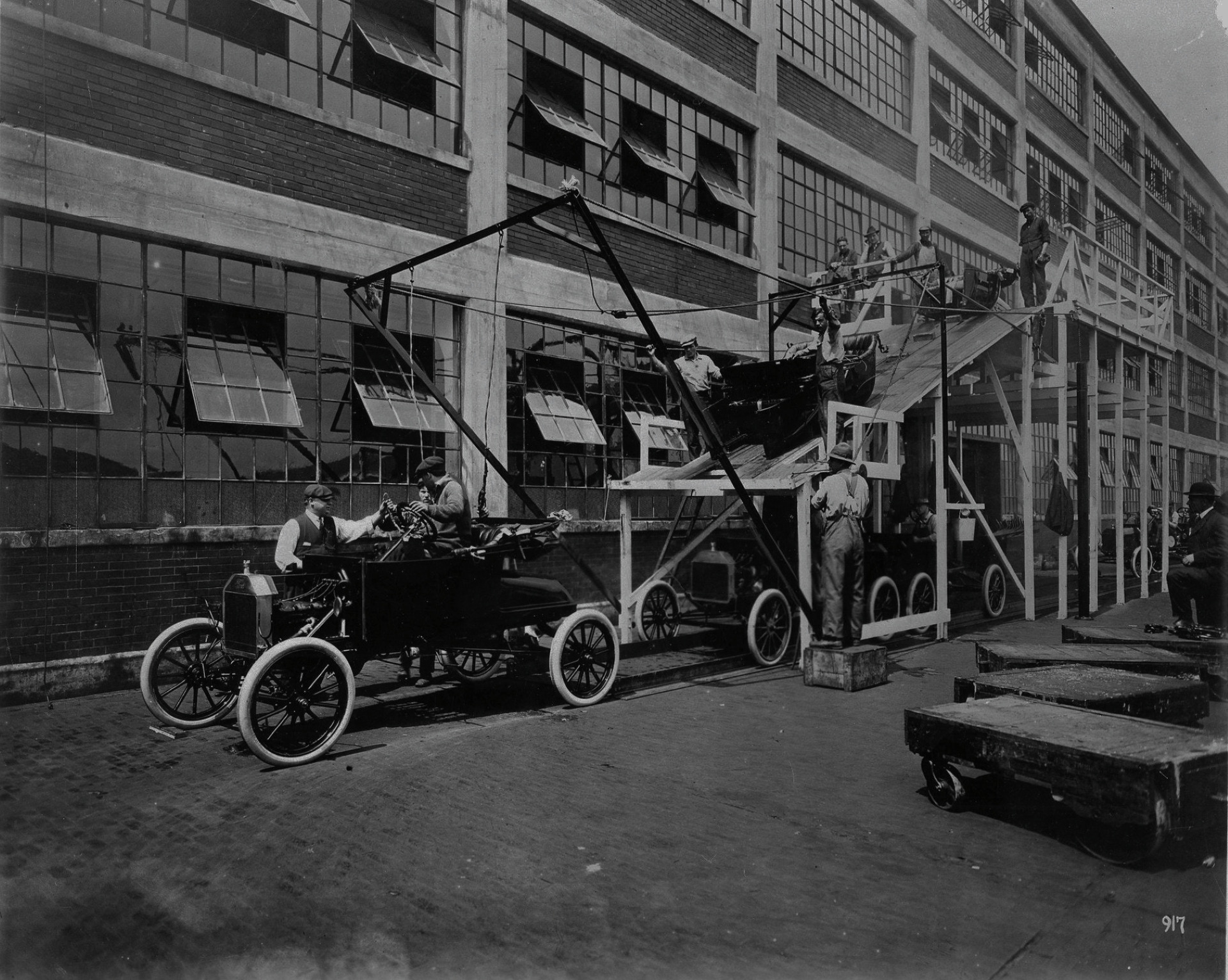
Image: Ford Motor Company
Tallulah Richards
August 28, 2026
Writing from his sprawling Salzburg Villa in 1925, Austrian writer Stefan Zweig cautioned of a conquest of Europe by America, identifying the intoxicating and homogenising nature of its imported “mechanical idea” as something “profoundly foreign to Europe”. Described by French poet Jules Romains as the “Great European”, Zweig was perennially drawn to visions of Europe, its complex heritage, culture and soul. His wistful prose reflects on the region as a transnational utopia of cultural and intellectual exchange, marked by an intangible spiritual current that weaves through the expanses of lands, from the cosmopolitan literary salons to the mountainous heart of the continent.
Through his eyes, automation, and by extension, Americanism, would cultivate a cultural monotony that would enslave the European individual, sanitising its rich traditions and aesthetics. He equated this process to a religious commandment or a dictatorship which seeks to indoctrinate the masses. The dissemination of new inventions, such as the radio and the ‘talkies’, was anathema to him. This objection concerned the influx of cultural imports, American mass entertainment, as well as the automated and passive modes of engagement with them. What would emerge, Zweig argued, would be a mimetic and zombified cultural autopilot that compelled adherence to trends, rather than valuing originality and the accumulation of meaning. The consequences for European society, culture and sensibilities would be sweeping.
Subscribe to FARSIGHT
Broaden your horizons with a Futures Membership. Stay updated on key trends and developments through receiving
quarterly issues of FARSIGHT, live Futures Seminars with futurists,
training, and discounts on our courses.
101 years later, in 2026, the polemic seems particularly prophetic, especially to those who disparage European reliance on US technology. Concerns span from lopsided infrastructure ownership patterns and the politicising impact of social media to more existential concerns regarding the consequences of AI on human agency and cognition. The ideological gulf across the Atlantic has never seemed so expansive or politically charged, which only serves to add to European anxieties.
Regarding Artificial Intelligence, Europe appears to be dogged by a Catch-22, forced to strengthen its economic and strategic resilience by playing a game of innovation keepy uppies while maintaining regulation that protects its populace and industries from the potential side effects. In July 2024, President of the European Commission Ursula Von der Leyen asserted the EU’s position towards AI, highlighting the dual goal of becoming a global leader in AI innovation, whilst also “tackling the risks stemming from its misuse” and “sustaining and improving our unique quality of life”. The EU’s push for strategic autonomy has been driven by mounting fears that Europe’s reliance on US-owned digital infrastructure could be used as leverage against it, with the risk of the US cutting the digital docking ropes and leaving the continent floating offshore. From the beginning of Trump’s second term, eleven ICC judges in the Hague have been put under US sanctions, effectively severing them from American digital infrastructure, unable to use ecommerce or even the European banking system. Anxieties have been piqued by the dawning realisation that technological ‘kill switches’ exist that could be triggered at the US government’s whim. In response, France announced its plans to replace Microsoft software with Linux and barred government officials from using popular American video conferencing and messaging apps as part of its digital sovereignty drive. By June 2026, this wary stance has expanded into more tangible action, with the nation spearheading a major investment initiative to construct a 5.1 GW AI-purposed data centre, poised to become the largest such facility on the continent. The Trump administration’s overt hostility towards Europe, illustrated by J.D. Vance’s adversarial Munich Security Conference speech, the Greenland flashpoint, the National Security Strategy (which portrays a failing Europe in need of guidance), and the imposition of tariffs, has done nothing to abate fears of an overstep.
This headache is compounded by discomfort at the deepening collaboration between the White House and Silicon Valley and the increasingly oligopolistic concentration of power in the hands of individuals who malign the EU’s regulatory principles. High-profile penalties on social media platforms for their violations of EU law have entrenched the animosity of Musk, Zuckerberg and allies in the Trump administration, fuelling narratives that frame EU regulation as a direct attack on free speech and American companies. This hostility has filtered down into the US right-wing rhetoric, amplified through these same platforms. Feeds are awash with the MAGA Europoor meme that satirises the EU’s regulatory stance and social models, deeming it to be emasculated by its risk-aversion. In Europe, parties previously aligned with and inclined to parrot MAGA talking points have distanced themselves from the US, spurred on by the awareness that alignment with Trump’s foreign policy and rampant pursuit of AI innovation is out of step with the national electorate. Anti-Americanism is seemingly back in vogue.
The gulf between the tech policies of the EU and the US has been articulated as the US push to ‘build first, regulate later’, the EU ‘regulate first, build later’. America’s AI Action Plan, instituted in July 2025, stated the intention to ‘remove red tape and onerous regulation’ to facilitate ‘unquestioned and unchallenged global technological dominance’ and ‘usher in a new golden age of human flourishing’. This reflects an offensive realist orientation that views technology as a tool of power projection, markedly distinct from the EU’s AI Act, with its precautionary approach anchored in a framework of multilateral cooperation and the construction of guardrails. Francesca Bria, Professor of Innovation at UCL, clarifies this divergence between Europe and the US in an interview with Noema Magazine, arguing that the key mismatch surrounds fundamental normative values rather than merely reflections of differing technological capabilities. She says that whilst “Silicon Valley optimises for extraction, Europe optimises for empowerment”. The consequence is two fundamentally different worldviews at loggerheads.
Some believe this divergence is the result of the EU attempting to protect its sovereignty, challenged as it is by a belligerent and volatile Trump administration. Through this lens, Europe’s historically cautious posture to tech can be seen as reactive rather than an integral component of its normative value system. But by reducing the transatlantic rift over the governance of technology to contemporary contingency we risk missing the bigger picture. The rift is not new. In fact, it’s reflected in a long lineage of European intellectuals who grappled with the automation they saw emanating from America and how it impacted and informed Europe’s understanding of itself.
The late 1890s marked a shift in the economic landscape of America. With the conclusion of the frontier, and as railroads and telegraph companies spread across the vast plains of the fledgling nation, the corporation began to supersede the entrepreneur. In 1908 Detroit, the production of the Ford Motor Company’s Model T car constituted a landmark in the transition towards mass production, solidifying assembly line methods as integral to productivity gains and economic prowess. The industrial might of the US was fomented. The Italian philosopher Antonio Gramsci described Fordism as a new form of “programmed capitalism”, with rationalism uniquely feasible in America due to absence of feudal traces and historical conventions.
America, with its rootless culture and propensity for invention and entrepreneurism, represented a dilemma for Europe. It provoked both intense fascination and consternation based on the scale and efficiency of its industry, as well as beliefs that encroaching automation posed an existential threat to European cultural and spiritual life. These hopes and anxieties became entrenched across the political spectrum, from far-right reactionaries to social democrats. Zweig’s polemic sits amidst this milieu, forming part of a broader European opposition to perceptions of American technological paradigms that appeared to privilege pace over precedents of craft.
In one of the first explicit definitions of Americanization in Europe, German author Paul Dehns, writing in 1904, describes the process as “the modernisation of the methods of industry, in the widest sense, the uninterrupted, exclusive and relentless striving after gain, riches and influence.” Other European writers expressed similar sentiments. From Kafka’s depiction of the feverish industry of a typing hall in New York City to Georges Duhamel’s scorn of the United States as the stronghold of the dehumanising machine, a genre surrounding the symbolic prospect of ‘America’ garnered status as a bête noire within many intellectual circles. Yet America became shorthand for anxieties about modernity outside literary circles as well. French Prime Minister Georges Clemenceau sneered that “America is the only nation in history which miraculously has gone directly from barbarism to degeneration without the usual interval of civilisation”.
This contrasts with the perspective of others, such as Weimar industrialist Walter Rathenau, who advocated that mechanisation was the key to succeeding in the modern world. European attitudes towards America have always been more complex than unadulterated disillusionment. Describing Americanism as a vague and capacious term, historian Philipp Gassert argues that “Americanism could refer to anything modern”. Instead of being viewed entirely as a hegemonic process, America can be seen as the subject of imagination, thereby acting as both a vivid language and a countermodel through which Europe – a region so defined by the past – could debate itself, its identity, and the future. Cultural historian Egbert Klautke suggests that there was a concerted attempt to “introduce a truncated version of Americanism to Germany” to implement its features of efficiency and rationalisation, but not its democratisation or mass consumerist principles. Mary Nolan, also a historian, makes the argument that Germans did not have a “desire for slavish imitation” of the American model, but rather that the country provided a version of modernity that could be adapted to fit their own vision of the future.
GET FARSIGHT DELIVERED TO YOUR INBOX
Explore the world of tomorrow with handpicked articles by signing up to our monthly newsletter.
As Europe rebuilt after the Second World War and the global competition between communism and capitalism began to define the international order, strategies of selective adoption became less pronounced. Anxieties surrounding the damaging effects of American mass production disintegrated along with the transatlantic realignment between Europe and the US. For a while, the wind was taken out of the sails of European resistance.
Yet the fall of the Soviet Union, coinciding with the 1989 invention of the World Wide Web and the unfolding of the Information Revolution, again reorganised the structures that conceptualised the role of technology and automation. In the US, heightened defence spending for the purpose of communist containment was no longer necessary, and tolerance for government intervention had shrunk. Instead, the economic emphasis was reasserted on markets and private initiative, and resources were directed towards technological development for commercial gain.
Historian Jeffrey Cooper argues that this funnelling into the digital represents a rekindled conception of the ‘frontier’ that featured all the deterministic markings of Turnerism and manifest destiny, provoking ‘the national spirit of invention and innovation’. European countries continued to benefit from adopting US technology, and American investment in European digital infrastructure allowed Europeans to pursue their own economic and industrial objectives. However, this has also led to a persistent reliance on American systems, instilling a catch up dynamic which has only deepened since. Whilst the US could afford to engage in high-risk, yet high-reward digital investments, Europe has not been as loss tolerant, both economically and for regulatory reasons – but arguably also due to cultural preferences for caution. Since the 1990s, American social media platforms and digital infrastructure have been broadly embraced by European users and companies, yet EU oversight and rules-based integration, such as the 1995 Data Protection Directive, the 2000 Electronic Commerce Directive and more recent acts such as the GDPR and the Digital Services Act, have demonstrated that selective adoption remains the preferred European strategy. Much like its historical approach to American automation imports during the Second Industrial Revolution, Europe has not been opposed to integrating American digital infrastructure where it improves industrial and public sector performance – but has consistently reached for regulatory levers when the same technologies threaten privacy, competition, or security.
The US continues to pursue scale and speed of innovation, with Silicon Valley chasing exalted visions of the cyber-frontier while Europe retains its preference for a cautious and user-centred approach. Yet in an era defined by borderless platforms and pervasive artificial intelligence, the strategy of selective adaptation may be fundamentally challenged. Much like how Americanism functioned as a language and model by which the ‘Old World’ could understand its own role and vision of modernity against the backdrop of the Second Industrial Revolution, Europe must now again glance across the pond to determine whether the American technological project remains compatible with how it envisions its own future. The question is whether ‘becoming slave to the mechanical idea’ that Zweig cautioned against is the inescapable prospect for Europe.