We use our own cookies, as well as those of third parties, for individual as well as repeated sessions, in order to make the navigation of our website easy and safe for our users.
In turn, we use cookies to measure and obtain statistical data about the navigation of the users. You can configure and accept the use of the cookies, and modify your consent options, at any time.
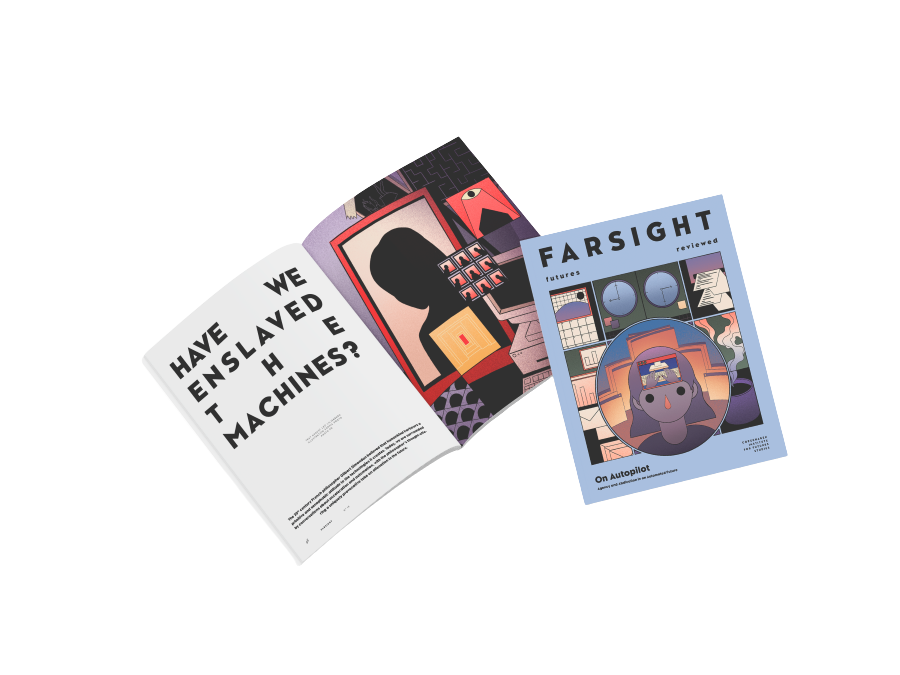
The 20th century French philosopher Gilbert Simondon believed that humankind harbours a primitive and xenophobic attitude to the technologies it creates. Today, we are surrounded by conversations about acceleration and automation, with the philosopher’s thought offering a uniquely provocative take on alienation in the future
Illustration: Sophia Prieto
August Leo Liljenberg
September 7, 2026
“I don’t take orders from clankers,” my friend tells me at the local Utrecht dive-bar, sipping his frothy Dutch beer. He shows me an Instagram Reel – or maybe the clanker is showing me it – of a Boston Dynamics robot humanoid being beaten up by an unwell homeless man in Los Angeles. We both expel a muted laugh: one that is clear enough to facilitate a budding friendship, while quiet enough to insure us against moral accountability. I make a lazy reference to the Dune franchise’s concept of ‘Butlerian Jihad’: a future crusade against thinking machines, which results in a civilisation restricted to only analogue technology.
“Scroll-up,” I tell him. He complies, followed by the sound of loud repeating whips bursting from his phone’s speaker. My friend frantically reduces the volume of the unexpectedly resonant lashes, which echo throughout the bar. In the video, the sounds are accompanied by the creator’s appropriate arm-movement towards an AI chatbot processing a prompt. “Take that, clanker!” the voice behind the camera says. The clanker seems to be answering something about homework, I think.
For those who are not terminally online, the internet neologism clanker is a derogatory term directed towards robots and artificial intelligence. Popularised in 2025 – already ancient in social media’s temporality – the word is increasingly used to assert a position of domination/subordination towards any technology perceived as automating labour problematically. In sum, man feels enslaved by technocapitalistic forces he perceives as out of his control, and projects these anxieties through a theatrical performance of violently subordinating machines.
Subscribe to FARSIGHT
Broaden your horizons with a Futures Membership. Stay updated on key trends and developments through receiving
quarterly issues of FARSIGHT, live Futures Seminars with futurists,
training, and discounts on our courses.
As is clear from my awkward bar scene, this jest can often be humorous, but also sometimes. . . odd. One answer lies in the term’s clear allusion to racial pejoratives. Critics on social media have argued that the term provides the (performatively) politically correct with a ‘safe’ outlet to engage in problematic power-fantasies. On the other hand, many have countered this criticism as an overreaction. The author Adam Aleksic – otherwise known as Etymology Nerd – has argued that it can be “cathartic to say ‘clanker’… because it’s always a joke in its core”, a kind of democratising lexical release of pent-up frustration against progress’s supposed twin: automation.
There is a problem, however. The irony of calling Claude a clanker is that doing so makes Claude a clanker – and Claude-as-a-clanker is exactly what the people who call Claude a clanker do not want Claude to be. That is to say: using the term indirectly anthropomorphises robots and artificial intelligence by granting them the necessary personhood to be enslaved, even though the impulse to coin the slur has arisen from anxieties about the bewildering development of the technologies themselves. The risk is that the term exists somewhere between a Catch-22 and a self-fulfilling prophecy.
What is the fundamental source of these anxieties? How legitimate are they, and how might we deal with them? The standard answer to this question lies buried in London’s Highgate Cemetery. In the mid-19th century, Karl Marx was concerned about the role machines had in distancing workers from the means of production. In his Fragment on Machines, Marx argued that technologies automating labour (known as fixed capital) in capitalist systems reduce the necessary labour of workers and increase surplus labour and value. In an ideal scenario, he entertained the possibility that this surplus value – which, naturally, is often taken by capitalists – is sublated into surplus time for the worker.
The Marxist interpretation of using the word clanker, then, is that it’s an attack on Big Tech by proxy for pocketing profits and steering machines towards a future against human interests. Their ideal world is something akin to the left-accelerationism of Fully Automated Luxury Communism, articulated in the titular 2019 book by British journalist Aaron Bastani. Machines will work according to human interests while we collect a fat UBI paycheck, painting and composing masterpieces while clankers whir in the background. What’s interesting to note, however, is that the clanker is still, well, a clanker.
But an attitude of subordination is not solely reflected among the modern-day proletariat. Similar beliefs can be found in the nexus of Silicon-Valley-Oxbridge discourse, too, where effective altruists wish to align superintelligence with human interests in fear of a Terminator-like scenario, and effective accelerationists (e/ acc, for short) want to move fast and break things. The former subordinates, and the latter personifies. It’s as if all positions in the contemporary debate surrounding automation hold the same clanker-adjacent assumptions about technology.
I want to entertain a radically different proposition: what if we took clanker roleplay seriously, and reframed the history (and potential future) of automation as one of man enslaving machines, rather than the other way around?
So believed the 20th century French philosopher Gilbert Simondon (1924-1989). Obscure in the Anglosphere (his works were first translated to English less than a decade ago), Simondon took a distinct approach to automation and alienation that diverged from the fervently Marxist milieu of post-war French intelligentsia. A physicist by training, Simondon argued that mankind harbours a “primitive xenophobia” towards machines, with the “most powerful cause of alienation in the contemporary world” residing not in an unequal economic relationship between workers and the means of production, but mankind’s misunderstanding of the tools he creates.
GET FARSIGHT DELIVERED TO YOUR INBOX
Explore the world of tomorrow with handpicked articles by signing up to our monthly newsletter.
As pioneered by the tradition of German philosopher Martin Heidegger, Simondon believed that technology mediates man’s relationship to nature. Technology is inseparable from man, or, in the words of American philosopher Katherine N. Hayles, that mankind has “always been posthuman”. Machines – technical objects, as Simondon called them – therefore have something human in them that becomes lost when they’re reduced to utility alone and left to operate automatically. When they become enslaved, that is.
Nearly seventy years after its publication, the philosopher’s 1958 magnum opus, On the Mode of Existence of Technical Objects, still feels like a breath of fresh air. In the book, Simondon approaches technology’s essence through detailing its evolution, maladaptation, and relationship to science, religion, and art. The systematicity is remarkable, comparable to an alien civilisation conducting ethnographic research on the tools we use. Its pages sprawl with black-and-white images of cathodes and catalytic converters; turbines and engines. Of course, the book is also a product of its time, written against the backdrop of the burgeoning information age and mass availability of sophisticated technical objects such as cars, televisions, and radios, whose inner-workings, Simondon feared, people were ignorant of.
Simondon’s principal worry was that for having such foundational status in mediating man and nature, we have yet to incorporate technical objects “into the world of significations”. Including foreign objects into a world of mutually recognisable signs is how we imbue them with meaning. Take the aesthetic object as a contrasting example. Works of art, which we all recognise have a human touch, have been granted an appropriate cultural milieu in which we can adequately engage with them. “Given we only have the aesthetic object,” Simondon quips, “people who like technical objects mistakenly make it the sacred object leading to idolatry”. Is it not this idolatry that we see across society, manifested in either undue hope or fear, pushing us to view machines as something separate to us to be subordinated?
This cultural malaise, Simondon believed, expresses itself by what we judge as technically advanced. Our ignorance of technology’s essence has made us associate technical sophistication with machines having a high degree of autonomy. It logically follows, therefore, that we assume political-economic sophistication consists in a hands-off approach to automation, too.
Simondon, however, argued that this misunderstands the unique evolutionary progress of technical objects. Automatism is regressive, he believed, in that it reduces machines to preconfigured operational schema, sacrificing a wider range of a technology’s possible uses. In doing so, culture collectively ignores the existential role of an ongoing, collaborative and reciprocal relationship between humans and machines. A progressive stance towards technology, for instance, would be one that ensures machines harbour a certain ‘margin of indeterminacy’with respect to their immediate environment, yielding an ‘open’ machine sensitive to outside information.
Here, the influence of postwar cybernetic thinking, with its emphasis on recursive causality and feedback loops, is apparent in Simondon’s thought. But in contrast to Norbert Wiener, the discipline’s founder, Simondon rejected the cybernetic dream of a ’machine of all machines’. Such a machine would neglect the role of humans in the vital act of invention – for Simondon, technical objects do not progress by becoming more autonomous, but by becoming more open to the humans who operate them. The technician and the inventor remain the irreducible condition of any machine’s continued development.
In contrast to Marx, who believed that automation-induced-alienation arose through an economic relationship between the worker and owner of the means of production, Simondon believed its origin lay in this fundamental misrecognition of technology’s essence. Hong-kong philosopher and Simondon scholar Yuk Hui has outlined this divergence through the example of artisan-turned-workers in 19th century England. Beyond the unequal economic relationship in the factory, these workers were alienated because they were reduced to users, “repeating their gestures according to predefined operational procedures and the rhythms of the machine.” This isn’t the fault of the machine or the capitalist, but a faulty culture that projects a schematic automatism onto the blueprints of technical objects, as well as the absence of technical knowledge in the worker. In Marxist terms, it is a problem of the base, rather than the superstructure. Over time, the former artisan turned user is estranged from both the machine and what it means to be human. Unable to act as the machine’s diagnostician or inventor, they lose touch with both.
To solve this malaise, Simondon suggested something akin to a cultural revolution of technical knowledge. He wrote at length on what the shape of education’s future should look like, arguing that “a child ought to know what self-regulation is, or a positive reaction is, in the same way a child knows mathematical theorems” and that the fundamental schemas of “causality and regulation” of technical objects ought to be taught in a “universal fashion, in the same way the foundations of literary culture are taught.”
The specifics of Simondon’s proposal seem outdated, yet his emphasis on technical knowledge is still prescient. The philosopher could not have predicted that in 2026, the platform economy has turned all of us into users of vast immaterial network infrastructures via digital technologies designed with seamless, automatic experience in mind. How do we solve this primal form of alienation and liberate technological objects when all that is solid has melted into air?
Answering this question was the task of the late philosopher Bernard Stiegler, for whom technology was a pharmakon – at once poison and remedy, the very infrastructure that reduces us to passive users being the only available cure. Since his death in 2020, that task has fallen to a small group of scholars – including the aforementioned Yuk Hui – who continue to repurpose Simondon’s work for the digital age.
Alas, any attempt to briefly summarise Simondon’s thought will be hopelessly reductive. Nonetheless, the philosopher’s basic ideas continue to serve as insightful provocations towards the way we talk about technology. At the very least, you might re-evaluate your triumph over machines by calling them clankers – whether by calling them clankers, or your warm embrace of their cold metallic flesh in your hopes of ushering in a (potentially) benevolent utopia, either in the form of the techno-singularity or fully automated luxury communism.
Back at the dive bar, it seems that I’ve zoned out. Luckily, the collective blood alcohol percentage of the group has ushered in literal and figurative myopia. I think they have forgotten the awkward video about the enslaved clanker. Wobbling across the sticky floor on my way to the smoking area, I decide to completely ruin the vibe of the hitherto amicable evening through a garrulous exposition of Simondon’s thought, accusing my friends of being xenophobic towards machines.