We use our own cookies, as well as those of third parties, for individual as well as repeated sessions, in order to make the navigation of our website easy and safe for our users.
In turn, we use cookies to measure and obtain statistical data about the navigation of the users. You can configure and accept the use of the cookies, and modify your consent options, at any time.
Grand historical narratives promise a future we can see coming. That is both their attraction and their defect.
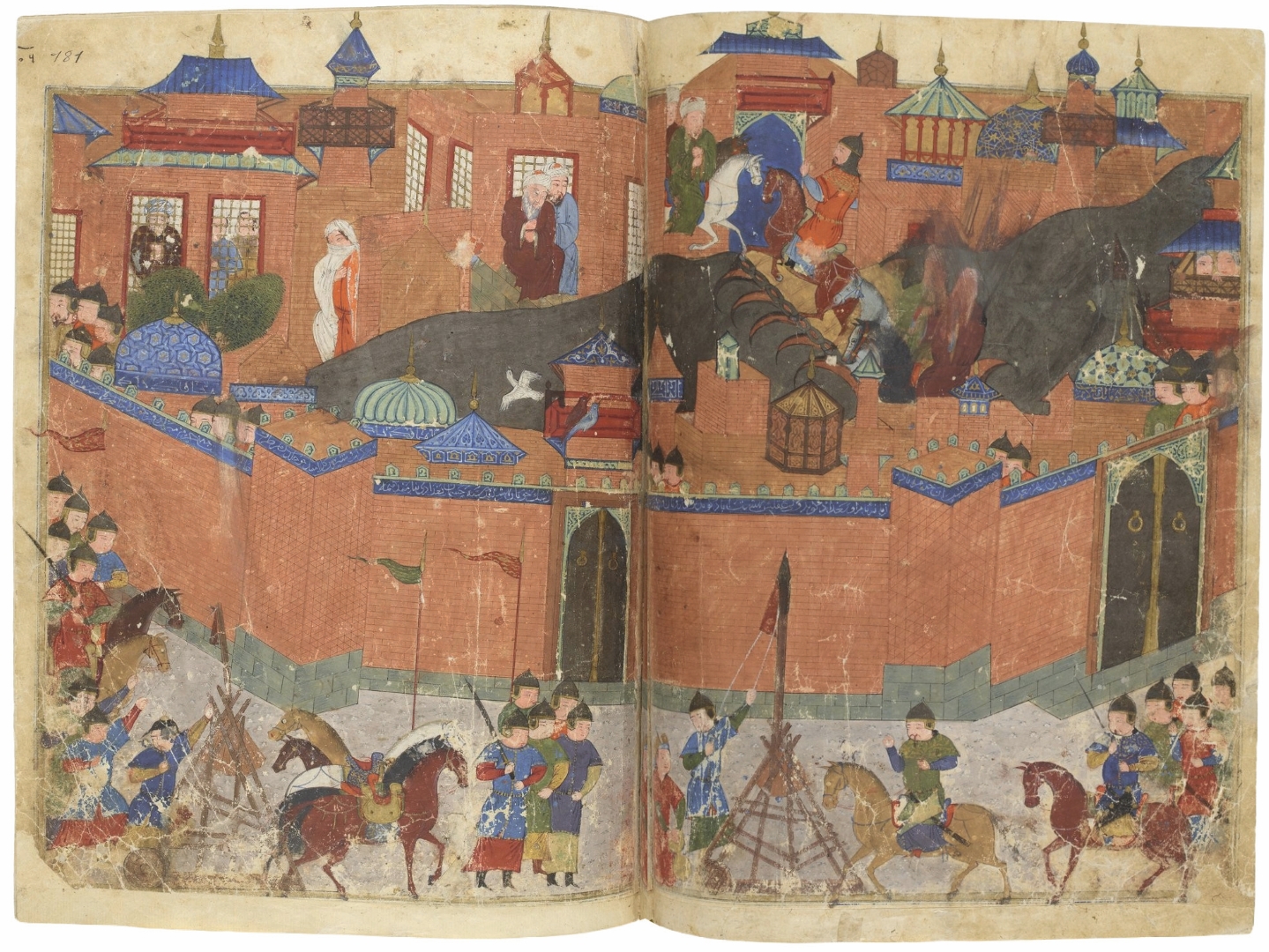
Illustration: Hulagu Kahn’s Siege of Baghdad 1258
Casper Skovgaard Petersen
October 22, 2026
In 1375, the Tunisian statesman and diplomat Ibn Khaldûn left civilisation behind and took up residence in a castle in a remote part of Algeria. In his early forties, his name was already recognised across the Mediterranean, although he had yet to leave his most lasting mark on the world. He had been a close confidant to sultans and government ministers, and was famous for his deep knowledge of Muslim law, Arabic literature and history, and for his fluent verse. His life up to that point had also been tumultuous, a long run of palace intrigues and of falling in and out of favour with different Muslim rulers. This was not least through Ibn Khaldûn’s own doing, him being a very ambitious man.
The chaos of Ibn Khaldûn’s personal life reflected the instability of the Islamic world in the late Middle Ages, which was marred by in-fighting, wars, and great external shocks. Just decades earlier, the Black Death had swept across the region, which was still reeling after the devastating Mongol invasions of the 1200s. The Christian reconquest of the Iberian Peninsula and the loss of major cities like Seville and Córdoba had left Islamic power severely diminished in Europe and had driven Ibn Khaldûn’s own family out of Seville generations before he was born. For any astute observer it would have felt like a civilisation in decline.
His more traditionalist contemporaries might have chalked up these misfortunes to the divine will of the omnipotent Allah. But to Ibn Khaldûn, the presence of God did not explain the causalities of history. It was during his refuge in Algeria that he would distil the secular trends he believed governed the rise and fall of states and put them on the pages of what would become his most famous work, the Muqaddimah. The book’s central idea was so novel and groundbreaking that it survives to the present day, where it takes the more farcical form of history moving through cycles of hard times producing hard men who will invariably dominate weaker ones, initiating new golden ages of prosperity.
Subscribe to FARSIGHT
Broaden your horizons with a Futures Membership. Stay updated on key trends and developments through receiving
quarterly issues of FARSIGHT, live Futures Seminars with futurists,
training, and discounts on our courses.
The Berber and Arab tribes of North Africa were Ibn Khaldûn’s hard men. Communities like this exhibited a strong version of what he called aṣsabṣíyah, the collective cohesion and sense of communal destiny that exists among tight-knit groups governed by capable chieftains and motivated by religious ideology. Throughout history, when such groups expanded and butted up against the borders of civilisation, it produced an almost tectonic effect that often led to the strong upstarts toppling the old order.
Over time, of course, these ruling elites would fall victim to the same entropy that had plagued their predecessors. This deterioration would run its course over a few generations, as dynasties progressed from genesis, to expansion, to prosperity and, finally, to decline. As the aṣsabṣíyah that animated ascendant groups weakened, vice and decadence set in, slowly poisoning the well of good governance until the next rugged band of frontier tribesmen would explode onto the scene and begin the cycle anew. In this way, new dynasties supplanted established ones, and civilisation, states, and empires progressed through cycles of decline and rebirth.
Ibn Khaldûn knew the main subjects in this story well, having worked as a power broker and interlocutor between urban sultans and the Berber and Arab tribesmen that they occasionally relied on for soldiers and tax revenue. Being no stranger to controversy and conniving himself, he routinely sought out these same tribes for protection as well. The Awlad ’Arif, the tribe who sheltered him at the mountaintop fortress of Qal’at Ibn Salama in western Algeria, practised a lifestyle not unlike that of the nomadic Arabs who had emerged from historical obscurity hundreds of years earlier, starting a series of conquests that would eventually expand Muslim civilisation from modern-day Spain to Pakistan.
More recently, in the 1200s, another nomadic people, the Mongols, had caused a traumatic disruption of that same civilisation. In accounts of Baghdad’s destruction by Hulagu Khan in 1258, the Tigris River was said to have run black with the ink from the city’s destroyed manuscripts and red with the blood of its inhabitants. A quarter of a century after drafting the Muqaddimah, Ibn Khaldûn would meet another great nomadic warlord, Tamerlane, and spend weeks in his camp outside Damascus, trying to convince him to spare the city of the kind of treatment that had befallen Baghdad. Supposedly, the two had many thoughtful conversations, and Tamerlane regarded Ibn Khaldûn with the utmost respect. Yet true to expectations, the Turco-Mongol conqueror still opted for brutally sacking the city.
This was Ibn Khaldûn seeing firsthand the cycle of creative destruction that he himself had described, and which to him constituted the great rhythm of history. His diagnosis, that this was a recurring (and in a sense productive) mechanism rather than a random act of violent destruction, is why he is often credited as being one of the foundational figures of macrohistory, the interdisciplinary study of the long-term trends and patterns that lie at the root of change.
The macrohistorical view transcends the borders (in time and space) that usually constrain the attention of historians. It is the attempt at a bird’s eye view of world history that searches for commonalities rather than accentuating the particular and the local. Ibn Khaldûn’s particular brand of macrohistory, concerned with seeking the inward principles of civilisation, has had a long afterlife since, including in the 20th century where it was taken up by the likes of Oswald Spengler and Arnold Toynbee.
Yet the suggestion that we can parse an essential logic from vast spans of history is not uncontroversial, for various reasons. Scientifically, it’s flying close to the sun for most historians trained to understand the trajectory of history as an intricate mosaic of contingency and causality. It’s difficult enough to piece together credible accounts from incomplete source material as it is, without also claiming to have discovered the underlying essence that causes things to swing this way or that.
Politically, such theories have been misused as well, by their repurposing into political projects minded towards crafting a preordained future.
What better example of the misappropriation of history than the Nazis. Before it became adopted by the national socialists, the Third Reich was the title of a 1923 book (Das Dritte Reich) by the conservative revolutionary Arthur Moeller van den Bruck. He cast the Holy Roman Empire as the first Reich and Bismarck’s empire of 1871 as the second, and called for a third one to sweep away the party politics of Weimar. Van den Bruck met Hitler once, in 1922, and was unimpressed. He killed himself in 1925. Yet the macrohistorical frame – that the first and second Reichs had highmarks in German civilisation, and that the social democratic Weimar republic stood in the way of a third iteration – was appropriated by the national socialists all the same, to give credence to their racial and millenarian political project. It was an abstraction that conveniently imbued the past with direction and destiny.
GET FARSIGHT DELIVERED TO YOUR INBOX
Explore the world of tomorrow with handpicked articles by signing up to our monthly newsletter.
It was partly because of the Nazis that philosopher Karl Popper claimed that any attempt at discovering the ‘rhythms’, ‘patterns’, or ‘trends’ that underlie history’s evolution is a dead end – at least if these were mistaken for ‘laws’. His argument was that the course of history is shaped by the growth of human knowledge, that we cannot know today what we will discover tomorrow, and that we thus cannot predict where history is going. In ‘historicism’, as he called it, he also saw the seeds of totalitarianism, stemming from what he deemed to be a hostility to open-ended scientific inquiry.
Popper wasn’t a neutral observer, and his historicism was a construct partly of his own prejudices, aimed at any philosopher, from Plato to Marx, who he deemed too closed-off in their thinking. Of course, not all grand sweep accounts of social change are millenarian, racial, or pseudoscientific by default. Some, like the works of the French post-war Annales school, stand out as hallmarks of historical scholarship. Yet the point that grand-scale histories, and the futures they hint at, tend to be made in the image of the present is evidently correct.
It was true for Ibn Khaldûn as well. What he didn’t live long enough to see was that the dynamic at the heart of his history – tribal upstarts injecting new blood into declining civilisations, would soon be broken by another great mover – technology. In this case: gunpowder. Tamerlane, who Ibn Khaldûn met with outside Damascus, did not represent just another revolution of the cycle. He would be the last great nomadic conqueror, his reign preceding the mainstreaming of gunpowder weaponry throughout Eurasia. Even the most skilled horse archer was little match for a peasant with a musket, and thus, Ibn Khaldûn’s great engine of history ground to a halt.
History didn’t end there, of course, and neither did attempts to decipher its rhythms. The staying power of grand pattern narratives is partly explained by the fact that they make for good stories, certainly ones with more mass appeal than the idea that historical change is simply contingency all the way down. They can also be used to give a sense of collective destiny, which of course can be put to darker ends.
The appeal of such narratives moves according to rhythms as well. It tends to grow along with a collective feeling of being at a hinge point, either at the cusp of greatness or decline, or facing off against some great adversary. In contemporary politics, they are invoked in this way, to bolster legitimacy and chart a desired way forward from the decisive “now”. When Xi Jinping speaks of China’s new role in the world – “changes not seen in a century” – he is invoking a macrohistorical narrative that situates the CCP as agents of a civilisational resurgence following the century of humiliation that began with the Opium Wars. In the West, whiggish end-of-history narratives, reaching their peak intensity during the era of hyper-globalisation that came to an end circa 2008, served to justify a liberal order at home and interventionist foreign policy abroad. The influential Russian ideologue Alexander Dugin’s division of history into an eternal dualistic struggle between sea power (the US and UK, favouring liberalism, individualism, and merchant values) and land power (Russia, favouring hierarchy, sacred tradition, collectivism, and stability) was an explicit counter to this Fukuyaman end-of-history thesis that positioned Western liberal democracy as the telos of political evolution. While his direct influence on the Kremlin is disputed, Russian foreign policy rhetoric mirrors the cultural and macrohistorical environment that Dugin has helped popularise among Russia’s conservative elite.
In this way, there is a reflexivity to grand historical narratives. When they catch on, they can become self-fulfilling prophecies that no longer describe the probable future but cause us to seek to either fulfil or counteract it. The Khaldûnian comparison is to a third-generation sultan heeding the warning of dynastic entropy and taking decisions to prevent his descendants from being toppled.
It’s not only within politics that sweeping historical narratives achieve reflexivity. Accounts of the past, present, and future of technology are full of it as well. Here, the notion of technological change being a linear path of accelerating returns naturally leads one down the track of predetermination. In the most confident accounts of the future, runaway artificial intelligence – the result of decades of compounding gains in computing – promises to end speculation itself, culminating in the singularity, a ‘solved world’, and the termination of history. Not only is the burden of proof for such scenarios massive, but the people making the decisions are often the same ones predicting their rapturous outcome – hence the reflexivity.
Long-range extrapolation based on historical trends can work, of course, and there are many conditions under which such predictions succeed, notably in closed systems characterised by high inertia and long lag. Demographic projections, while neither completely precise or a fully closed system, rest on the fact that people who will be sixty in 2070 are already alive, and that certain things like health and education are determinants of how many children people tend to have. Based on cohorts that already exist, and in the face of dwindling birth rates, demographers can say with confidence that the population pyramids in Europe and East Asia will keep inverting. Their epistemic limits have less to do with a fundamental barrier to anticipate, and more to do with access to information or the ability to obtain it. Futurists sometimes refer to these phenomena as megatrends, which are not exactly predictions of the future but perhaps the closest we can get to such a thing.
It could be that uncertainty itself is what permits the proliferation of reflexive macro narratives. If history could be read and projected to the degree that demographics can, there would be little need or space for seeking out an inner essence to project into the future. It’s very natural to seek assurance in the face of the unknown – and likewise, fully expected that those in power use the uncertainty of others to their own benefit. But they, too, will be surprised. The thing that broke Ibn Khaldûn’s engine was not a flaw in his reasoning but a technology nobody had imagined the significance of. Openness of that kind is a difficult thing to live with, which explains why we are so short of accounts of the future in which the ending has not already been settled.
This article was published in Issue 19: The Problem of the Future