
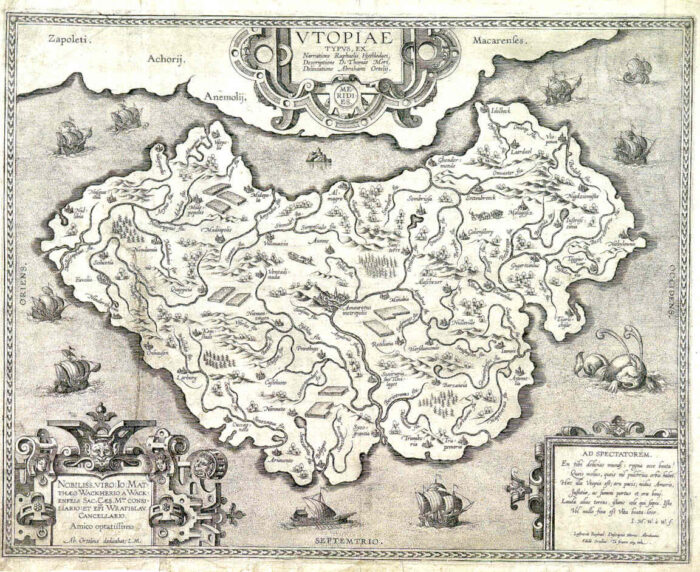
The Ambiguity of Utopia
Suspended between reality and fiction, the emancipatory and the fatal, two conflicting meanings have clung to the word utopia for centuries.

Trains and rail once symbolised progress and modernity. Today, they have more-so come to represent ideas of social equity and public good – an unassuming but universally accessible means of transport. Could rail reclaim its lost significance and prestige – and if so, what would it take?
When Vladimir Lenin took one of European history’s most fateful journeys in 1917, he did so by train.
It took him eight days of travel from departure to arrival (seven days discounting some time spent in Stockholm) to get from Zürich to St. Petersburg. He crossed through five countries in central and northern Europe before arriving at his destination, where he famously gave a speech from atop an armoured car. Revolutionary politics and train rides have a long-shared history. Supposedly, Gandhi being thrown from a train carriage in South Africa in 1893 provoked his resolve to fight British colonialism. And although historians have concluded that the trains didn’t actually run on time in Mussolini’s Italy, it was nevertheless a fixture of fascist propaganda – obsessed with efficiency, speed, and technology as the fascists were.
Broaden your horizons with a Futures Membership. Stay updated on key trends and developments through receiving quarterly issues of FARSIGHT, live Futures Seminars with futurists, training, and discounts on our courses.
become a futures memberGoogle Maps will tell you that Lenin’s journey takes you around three days to complete today, with numerous stops and changes along the way. Not exactly a huge improvement considering we benefit from over a hundred years of innovations in mobility and infrastructure, not to mention the luxury of passport-free travel in Europe’s Schengen zone.
Few would consider taking a similar journey by train today. Privatised travel by air and road have supplanted rail as the dominant form of motorised transport. In peacetime, a passenger plane could take you from Zürich to St Petersburg in a few hours. By car, Lenin’s journey through Switzerland, Germany, Poland, the Baltics and into western Russia would take you over 29 hours of non-stop driving. A similar journey by public transit would no doubt be an infinitely more frustrating affair.
Trains and rail once symbolised progress and modernity. Maglev trains and highspeed rail still command a similar fascination. But compared to the sense of progress felt when the first railways were laid down, trains have more-so come to represent ideas of social equity and public good – an unassuming but universally accessible means of transport. A train will take you where you need to go in a way that (usually) doesn’t break your budget, but depending on your journey it won’t necessarily be the fastest or most reliable way to get there. On short to medium distances, a car will probably be quicker. Over longer distances, air travel reigns supreme. Could rail reclaim its lost significance and prestige – and if so, what would it take?
It might seem like a naive question. Perhaps it’s a foreclosed conclusion that other forms of travel have won out and will continue to dominate. And why shouldn’t they? Europe is a patchwork of sovereign states and a chaotic bundle of separate rail systems. Everything from signalling design to platforms heights differ, making interoperability difficult.
But rail still has advantages over competing modes of travel. A journey by train requires no long check-in time and elaborate luggage restrictions. Seating is usually more spacious than for air travel and the journey more comfortable and relaxing. Cross continental journeys by train, perhaps even by sleeper train, have an air of laid-back romanticism about them. Someone else does the steering for you, and stations tend to be located centrally in cities. The Wi-Fi might actually work.
But rail’s standout advantage – the one that makes pondering whether it has a bright future in Europe a worthwhile exercise in the first place – is that it’s a much more sustainable way to travel than road and air. Trains may be the older technology, but they’re arguably a better fit for a future that requires massively reducing our carbon footprint – of which transport makes up a sizeable share.
According to the European Environment Agency, transport accounts for around a quarter of EU greenhouse gas emissions. Road transport takes the lion’s share (72%) followed by aviation (13%, but with much higher emissions per km travelled). Rail’s share of emissions (albeit only for diesel trains) is only 0.4%. Boarding the Eurostar high-speed rail in France instead of booking a seat on a short-haul flight would cut your journey’s CO2 emissions by 97%, according to data from the UK Government’s Department for Energy Security and Net Zero. With EVs gaining ground, emissions from car travel will decrease. But air travel will remain a highly polluting form of travel for the foreseeable future.

Explore the world of tomorrow with handpicked articles by signing up to our monthly newsletter.
sign up hereIt’s clear that trains are the eco-sensible choice. But travellers will rarely make decisions based on good intentions alone. In the age of low-fare airlines, travel by rail would need to be made quicker, cheaper, and more convenient to become competitive over longer distances. And there’s no shortage of obstacles to achieving this. One of the more significant ones is how difficult it is to align Europe’s many different systems and standards.
“Harmonisation has been slow. Due to different track and loading gauges, different electrical systems and above all different signalling systems, it’s far harder than getting inter-operability in other modes [of transport],” says Roger Vickerman, Professor of European Economics at the University of Kent. Vickerman has done extensive research into major infrastructure projects, such as The EU’s trans-European transport network (TEN-T) and various high-speed rail projects on the continent.
Rail, he explains, must be planned as an interconnected system across all types of operation – high-speed, conventional inter-city, regional, urban, and suburban, while also allowing access for freight. The need for simplification and integration is clear, but the challenge is massive, and sometimes it has clashed with other priorities on a policy level.
“I think there has been a confusion in European rail policy between the desire to achieve TEN-T rail projects as part of the integration programme and the desire to increase competition through the separation of track and train and encouraging open access,” says Vickerman. “These are arguably incompatible objectives that ignore the fact that competition in rail is actually from non-rail modes (air and road) that are less subject to political control.”
Others see the challenge differently – as one that also has to do with a lack of ambition and visionary thinking on the EU policy level.
21st Europe, a Copenhagen-based think tank, has developed a blueprint for a European high-speed rail network connecting the continent’s metropoles as if they were metro stops in a city. Kaave Pour, 21st Europe’s founder, says that he thinks Europe lacks a unifying vision for rail, and that it has taken a reactive stance for too long.
“What Europe lacks isn’t technical capacity, it’s a narrative that makes large-scale collaboration feel necessary and achievable,” he says.
Starline is meant to add something that’s been missing from Europe’s current and planned cross-border upgrades, Pour explains, in the form of public engagement. The deep blue colour of the trains was chosen deliberately to make Starline as recognizable as the yellow taxi or the red double-decker bus. The trains’ interiors, too, will tell a story. They are envisioned as welcoming spaces that emphasise comfort and communal traveling.
“The dominant vision of the future today is often built around isolation: private pods, autonomous vehicles, endless sprawl. The cybertruck is a perfect symbol of that logic. It’s engineered disconnection,” says Pour. “We don’t subscribe to that future. Starline offers an alternative, one that’s public, shared, and civic. And that’s why things like the name, the typography, even the colour of the train, matter. These are not surface details. They’re how Europe becomes tangible to the people it serves,” he says, and continues:
“Europe has built extraordinary cross-border systems before: the Euro, Schengen, Erasmus, Galileo. None of them were simple. But they succeeded because there was political will, institutional coordination, and most importantly, public belief. That’s what’s missing now,” Pour says. “Rail is one of the few forms of infrastructure that people experience directly. It’s where mobility becomes personal, where borders disappear in practice, not just in principle.”
Transport and travel may not figure centrally in narratives of European community building. But it’s always been an important component of it. While few Europeans may know what TEN-T is, or which major rail infrastructure projects are planned or currently under construction, most know about Interrail, the travel pass that has attracted European youth since the 70s. Many have fond memories on going train hopping through Europe themselves – by estimates 600,000 Europeans in total. It’s become a cherished cultural institution.
For a case study in the role rail infrastructure can play in the harder aspects of polity and state building, some look to China. In the span of just a few decades, a web of high-speed rail has connected the country’s disparate megacities as part of a concerted effort to boost economic development, regional integration, and public mobility.
Rail has also become an important component in China’s foreign policy ambitions, exemplified by the massive Belt and Road Initiative stretching across Eurasia along the Silk Roads that the Mongol Khans once presided over. The completion date of 2049 will coincide with the 100-year anniversary of the PRC’s founding.
In the Chinese context, rail is evidently more than a public good. It has also become a symbol of national prestige and technological sophistication. Although it shows the power of a grand unified vision, comparisons to Europe’s situation tend to fall short.
“Clearly the planning system in China has helped execution of the policy, but also starting from a low base and in a period of rapid economic growth has helped,” says Vickerman. “Geography also plays a part,” he continues. “The average distances between the main economic centres in Europe are much shorter than those in China, and densities of population outside cities are also greater in several countries.”
For Vickerman, the economic case for a similar major rail expansion throughout Europe is not clearcut. “Ultimately, China is one large country, and for geographical, social and economic reasons, as well as political ones, regular international travel in Europe is at a much lower level. Yes, rail could increase its share of cross-border traffic, but we are talking about relatively small market shares that would not justify much new construction, especially if it were dedicated only to high-speed passenger traffic and did not involve expensive construction of tunnels through mountain ranges or bridges or tunnels across sea channels,” he says.
Yet economic development and cultural integration may not be the only motivating factors for expanding and harmonising Europe’s rail. In a geopolitically more fraught world, the need for security could help create a sense of urgency that wasn’t there in the past. Finland’s announcement in May 2025 to adjust the gauge of its railroad tracks to the European standard in accordance with TEN-T recommendations, despite the previous government having stated it wouldn’t be cost-efficient to do so, is a case in point.
The statement from the Finnish Ministry of Transport emphasised the importance of cross-border military mobility, civil preparedness, and security of supply. The switch in gauge width will be made from 1524mm, the same size that tsarist Russia operated with, to the narrower contemporary European standard.
It’s a move that could signal other changes to come. As Europe strives for greater autonomy and self-sufficiency in more dimensions, perhaps rail infrastructure could serve as both a practical and symbolic means of achieving these goals. Railways, once emblematic of progress, modernity, and the dissolution of geographical and cultural divides, could once again become central to more unified visions for Europe’s future.
“If the EU wants to demonstrate its value in people’s daily lives, this could be one of the clearest ways to do it,” says Pour. “You could say that Europe likely needs more than integration. It needs more identity.”

This article was first published in Issue 14: European Futures